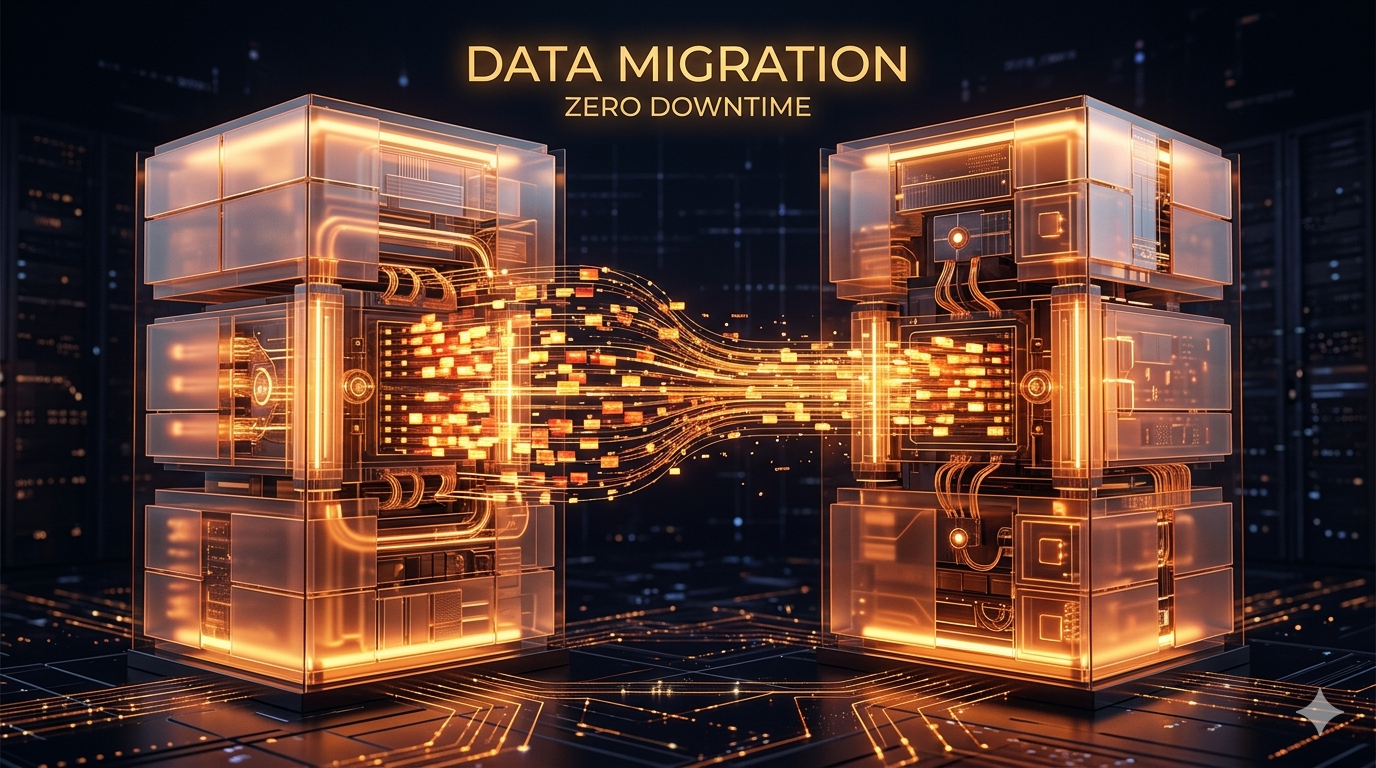
Replatforming an enterprise web application is notoriously risky. When a platform is processing thousands of transactions a day, you cannot afford a "maintenance window." Yet, legacy monoliths eventually become too slow and brittle to support modern conversion rates.
Here is the exact engineering playbook we use to migrate enterprise platforms to modern, headless Next.js architectures with absolutely zero downtime.
1. The Parallel Build Protocol
We never modify the legacy system. Instead, we build the new headless architecture (Next.js frontend, microservices API layer) completely in parallel. The old system continues to serve 100% of production traffic while the new system is built, tested, and staged in an isolated environment.
2. Bi-Directional Data Syncing
The hardest part of a migration is state management. We implement a temporary middleware layer that listens to the legacy database and syncs mutations (new users, orders, inventory changes) to the new database in real-time. Both databases remain identical up to the millisecond of the cutover.
3. The Canary Routing Strategy
We do not flip a switch and hope for the best. We use Edge routing (via Cloudflare or AWS Route53) to implement a canary release.
- Day 1: 1% of traffic is routed to the new platform. We monitor error logs and Core Web Vitals.
- Day 3: Traffic is increased to 10%.
- Day 7: Traffic is increased to 50%.
- Day 10: 100% cutover.
If at any point an anomaly is detected, the Edge router instantly falls back to the legacy system. The risk profile is reduced to zero.
"A 100ms improvement in page load time drives a 1% lift in conversions. We obsess over every millisecond because every millisecond is measurable revenue."
The Result: Speed as Revenue
By decoupling the frontend from the backend, we push static assets to global Edge CDNs, resulting in sub-100ms load times. For a recent eCommerce client, this zero-downtime migration resulted in a 78% improvement in Largest Contentful Paint (LCP) and a direct 3× lift in their mobile conversion rate.
We built the exact systems described in this article.
Book a free 60-minute diagnostic call. We'll map your specific situation, identify your highest-ROI automation opportunity, and scope a fixed-price engagement.
Start Free Audit